I said I’d tell you honestly how it went. So here it is.
Charlie, our 90-lb German Shepherd, did better than usual this year. I want to be careful about how I say that, because I can’t hand you a clean before-and-after — I don’t have a control group, just one dog, one night, and a lot of paying attention. This was the first year we tried a calming treat alongside our usual fireworks routine — VetriScience Composure Calm & Confident Thunderstorms Support Chews, the chicken-flavored ones. It’s a supplement, not a medication — built around natural ingredients like colostrum protein and L-theanine, nothing synthetic or sedating. Here’s everything I noticed, for whatever it’s worth.
The first fireworks of the night — the far-off, quieter ones — usually mark the beginning of the bad part. Not this year. Charlie was up on my bed, looking out the window, clearly hearing them. My dad was sitting on the ottoman right next to the bed with his arm resting near him, close enough for Charlie to feel him there. His head would come down, and he’d end up laying fully on the bed — 9pm is just his bedtime, and I’d tired him out more than usual that day, so that part wasn’t the treat at work.
One honest complication worth mentioning here: Charlie’s been recovering from a hurt paw pad, and because of it, he’d stopped using his usual path onto that bed — up onto the ottoman first, then a jump from there onto the bed, like a stepping stone. When I walked in and saw him already up there with my dad, I was genuinely surprised. I can’t say for certain the treat had anything to do with it, but some part of me thinks it might have played a small role. I don’t want to oversell that — his paw was healing on its own timeline regardless — but I also don’t want to pretend I didn’t notice it.
Then the real fireworks started, the loud ones, and he did what he always does — bolted straight for his crate. We went into the routine: my dad’s arm reaching in through the bars on one side, me on the other, Pachelbel’s Canon in D playing on repeat. Three rounds of it before we let other classical music take over.
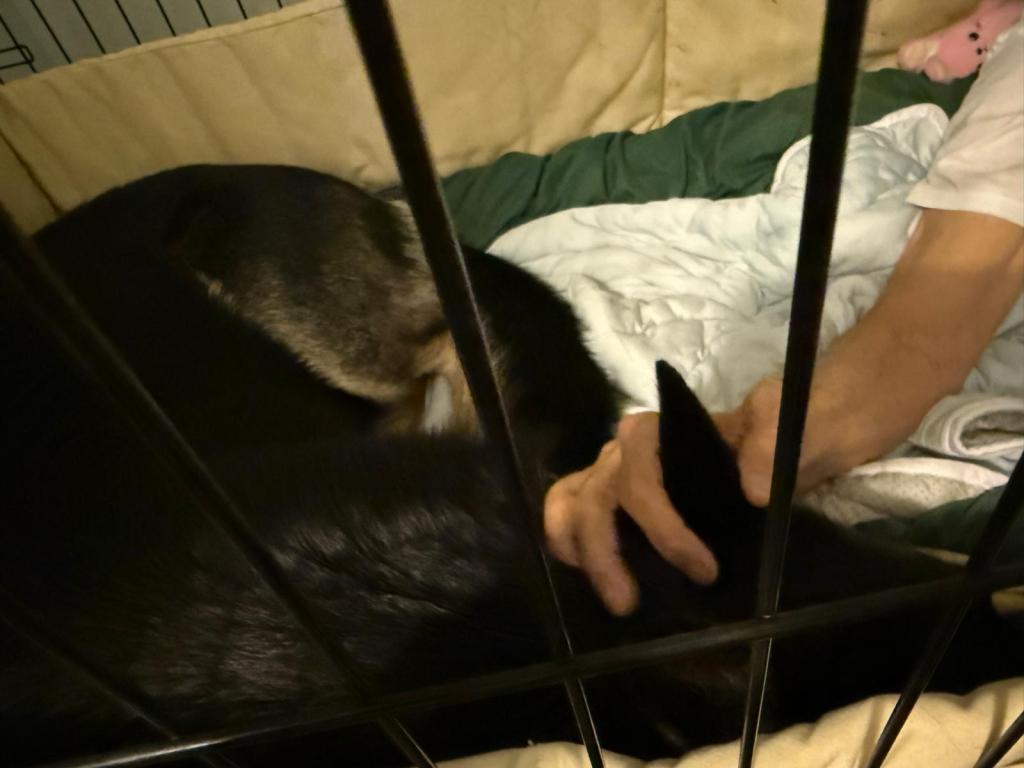
I could read him song by song. When he started settling — head going down, curling in — I’d let whatever was playing continue. But the moment I saw him tense back up, I’d go straight back to the Canon. At some point I noticed two other songs doing the same thing the Canon does — within seconds of them starting, his head would start to lower. Chopin’s Nocturne in E-flat Major, Op. 9, No. 2. Mozart’s Piano Concerto No. 21, the Andante movement. I don’t know if it’s the tempo, the softness, something about the register — but I know what I watched happen, twice, on two different songs.
When it was over, he bounced back fast. Last year, that part took considerably longer — a slow, unsettled stretch where he stayed anxious well after the noise had already stopped. This year he was just… done. Back to being Charlie.
I’m not going to tell you the treat is a miracle. I’m going to tell you what I told you I would: it seemed to help, and he settled back down faster than he did last year. As for the music — that’s not something I figured out overnight. Charlie can’t tell me in words when something’s working or when it isn’t, so noticing things like that has always come from paying close attention, over years, not one lucky evening. That’s just what it looks like to know your dog when you can’t talk to each other directly. Take all of it for whatever it’s worth to your own dog.
 Directed by Charlie